Kawartha Scale Modellers | Bench Standard
Scale Modelling Masking: Tamiya Tape, ORAMASK 810 and Airbrush Markings
Masking failures are not morality tales about tape. They are process failures created when a gap, an airstream, and a mobile paint film meet at the same moment. Control those three variables and masking stops being drama and starts becoming a finishing system.
Fast Entry Bench Summary
- Tamiya tape has the wider operating envelope. It curves better, settles better, and forgives more bad behaviour.
- ORAMASK 810 is stronger for hard-edged insignia, serials, tactical symbols, and crisp stencil geometry.
- Lacquer punishes sloppy masking more aggressively because it atomizes finer, stays mobile longer at the edge, and bites harder.
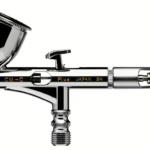
- The MAC Valve matters because it controls delivered airflow at the brush, not just tank pressure at the regulator.
- Masking success depends on edge burnish, spray direction, airflow control, dilution discipline, and restrained film build.
- The goal is not brute opacity. The goal is a marking that looks painted into the surface rather than stacked on top of it.
Why Professionally Designed and Cut Masks Matter
Professionally designed and cut masks are not a convenience product for weak technique. They are a finishing tool for modellers who care about geometry, film control, and surface integration. A serious modeller is not simply trying to get a marking onto the model in roughly the right shape. The objective is a marking with cleaner edges, lower paint build, tighter spacing, and a result that behaves like paint because it is paint.
That is the real difference between a mask and a decal. A decal can reproduce artwork. A mask allows the marking to become part of the finish system itself. Reflectivity, texture, weathering response, and optical behaviour stay in the same family as the surrounding paintwork. Even when a sprayed marking has slight tonal variance or minor human irregularity, it often looks more convincing because the imperfection belongs to the painted object rather than to an added film trying to disappear.
Professionally designed and cut masks are not a shortcut. They are a higher standard.
1. Mask Material Doctrine: Not All Masks Fail the Same Way
Masking materials are not interchangeable. They do not all fail for the same reasons, and they do not behave the same way with lacquer and water-based acrylic. The first mistake many modellers make is treating all masks as if they only differ in price. They differ in structure, flexibility, tack behaviour, edge response, and tolerance for bad airflow decisions.
Tamiya Masking Tape
Tamiya tape is thin, conformable, and forgiving. In real bench use, that means it settles well over subtle surface variation, curves more willingly, and is generally more tolerant of imperfect operator behaviour. Its washi-paper character gives it a broader working envelope, especially when lacquer is involved.
- Best for curves, compound shapes, and mixed-surface work
- More forgiving around rivets, shallow detail, and uneven surfaces
- Better choice when your workflow is still being refined
- Usually the safer answer when lacquer risk is high
ORAMASK 810 Vinyl
ORAMASK 810 is a low-tack stencil film built for precision masking. It offers excellent visibility of the substrate and strong geometric definition, but it is still a non-porous vinyl film. If airflow gets aggressive and paint remains mobile, vinyl will not save sloppy technique. It rewards accuracy more than it forgives error.
- Best for hard-edged insignia, serials, codes, and stencil geometry
- Excellent visual clarity during placement
- Less forgiving on compound curves and broken surface detail
- Rewards disciplined spray control and restrained passes
Bench Rule
Use the mask that matches the job, not the one you happen to be holding.
Mask Chooser: Use the Right Material for the Job
| Task | Best Choice | Why |
|---|---|---|
| Curves and soft compound forms | Tamiya tape | Conforms better and tolerates imperfect geometry |
| National insignia and hard-edged markings | ORAMASK 810 | Crisp stencil logic and strong shape fidelity |
| Rivets, weld seams, broken surface detail | Tamiya tape | Settles more willingly and punishes less |
| Serials, codes, and sharp letterforms | ORAMASK 810 | Better visual registration and clean linear edges |
| High-risk lacquer work | Tamiya tape | Broader operating envelope under stressful conditions |
| Large flat fields and stencil-type layouts | ORAMASK 810 | Stable geometry and easy placement visibility |
| Operator still refining spray control | Tamiya tape | Forgives more bench error |
2. Why Masks Fail: The Fluid-Dynamics Version
Paint does not mysteriously sneak sideways under tape. It is driven there. For bleed to occur, three things must exist at the same time: a gap, energy, and a mobile paint film. Remove any one of those and the failure stops.
- A gap — microscopic is enough
- Energy — airflow volume and nozzle velocity
- Mobile paint — thin paint plus active solvent
That is why masking cannot be reduced to tape brand arguments. Tape matters. Surface prep matters. Cure matters. But when the brush is driving a wet film into an edge with too much energy, the operator has already created the failure mechanism.
The gauge does not tell you what the nozzle is doing in reality.
3. Lacquer Versus Water-Based Acrylic at the Mask Edge
Lacquer is not dangerous because it is evil. It is dangerous because it is efficient. It atomizes finer, stays mobile at the edge, and chemically bites into what is underneath. That means lacquer failures often look darker, wetter, glossier, and more intrusive. Water-based acrylic is generally more forgiving under a mask, not because it is better, but because it is coarser and less eager to run into microscopic gaps with the same aggression.
| Paint Type | Edge Behaviour | Typical Failure Signature |
|---|---|---|
| Lacquer | Fine atomization, high mobility, solvent bite | Directional undercut, dark edge stain, ghost halo, aggressive bleed |
| Water-based acrylic | Coarser droplet structure, higher surface tension, softer coalescence | Pebbling, bridging, softer edge fuzz, less chemically intrusive failure |
Doctrine Note
Lacquer exposes every mistake faster. That does not make it the wrong medium. It means your masking process has to be worthy of it.
4. Full Bench Workflow: How to Mask and Spray Markings Properly
This is the practical sequence that keeps masking under control. Skip steps, compress cure time, or chase opacity with wet passes and the process degrades quickly.
- Start with a clean, stable surface. Dust, sanding residue, skin oils, and semi-cured paint undermine edge sealing and increase lift risk.
- Let the underlying paint cure properly. Touch-dry is not the same as cured. A surface that feels dry can still be vulnerable to adhesive pull and solvent attack.
- Choose the right masking material for the shape. Do not force vinyl to behave like kabuki paper, and do not expect kabuki tape to deliver complex stencil geometry as cleanly as a purpose-cut vinyl mask.
- Apply the mask without tension. Stretched masks try to recover. Recovery creates lift, distortion, or edge instability.
- Burnish the edge, not the whole field. The edge seal matters. Overworking the full mask area adds little benefit and increases the chance of distortion or unwanted adhesive contact.
- Spray a light sealing pass first. This can be a dry mist of the base colour or a very restrained first pass of the marking colour. The aim is to establish the edge, not flood it.
- Spray away from the edge first. Do not lead with a pass that drives paint directly into the mask boundary. Approach the edge with discipline.
- Build the colour gradually. Several light passes are safer than one wet pass. Masked markings fail when the operator chases opacity with volume.
- Control airflow at the brush. This is where the MAC Valve becomes decisive. Lower destructive edge energy, reduce the initial hit, and keep the spray cone under control.
- Watch film build as closely as colour density. A marking can be perfectly sharp and still fail because it sits as a raised patch on the surface.
- Remove the mask when the paint has set, not days later. Leave it too long and the film hardens around the edge, increasing the chance of ridge formation or mechanical tearing.
- Inspect under raking light. A marking that looks fine head-on may still show a paint terrace, shadow line, or hidden edge contamination under side light.
5. Failure Ladder: Read the Edge Correctly
Not every imperfect edge means the same thing. Read the failure properly and the solution becomes obvious.
- Soft feathered edge — mild diffusion, often acceptable, usually the result of light overspray or a less aggressive film
- Directional undercut — airflow was too strong or the pass was too wet and driven into the edge
- Ghost edge or stain halo — solvent migrated and marked the boundary even if the hard bleed was limited
- Paint lift — underlying coat was not cured enough, adhesion was poor, or the mask bonded more aggressively than the substrate could tolerate
- Raised terrace — colour coverage was achieved by piling on paint instead of building a restrained integrated film
Diagnostic Indicator
Masking failures are more often process failures wearing a materials costume.
6. Why the MAC Valve Changes Everything
The regulator controls system pressure. The MAC Valve controls delivered airflow at the brush. That difference is not trivia. It is the breakthrough. Instead of making coarse compressor-side adjustments and hoping the spray behaviour follows, the modeller can keep the supply steady and reduce destructive energy exactly where it matters: at the edge.
- It softens the initial trigger hit
- It reduces the chance of blasting the mask edge open
- It allows a dry sealing mist before the main colour pass
- It makes low-build masking work more repeatable
- It turns edge control from guesswork into process
If airflow is not controlled, tape is irrelevant.
7. Paint Film Accumulation: The Problem Is Not Just Edge Sharpness
Every decal is a film. Every sprayed marking is also a film. The difference is that decal thickness becomes obvious when carrier film, silvering, or trapped air reveal it, while sprayed markings often hide their own thickness until side lighting, macro photography, or weathering exposes the step.
This is the missing connection many modellers overlook. You can produce a sharp marking and still fail the finish if the paint stack is too high. Spray an RAF roundel, multi-colour insignia, or tactical marking with brute-force opacity and every colour ring becomes another physical layer. The marking may be sharp, but it no longer looks integrated.
- Reduce the paint enough to build opacity gradually
- Apply light passes and allow each to flash off
- Stop when the colour reads correctly, not when it becomes brutally solid
- Judge under raking light, not only under direct bench light
Bench Standard
The best sprayed marking is not the one with the hardest edge or the strongest colour. It is the one that still looks painted into the vehicle rather than painted on the vehicle.
8. Tape Edge Test: A Simple Way to Judge Paint Build
One of the simplest ways to estimate paint film thickness is to use masking tape as a temporary height gauge. Spray across a tape edge on a test card or scrap panel exactly as you would a marking. Remove the tape once the paint has set enough to handle cleanly. The remaining edge becomes a witness line.
- If the transition is subtle and only just visible under raking light, the film build is in the right zone.
- If the edge reads as a hard ridge, catches a fingernail, or throws a shadow, the paint was applied too heavily.
- If it looks acceptable head-on but turns into a terrace under macro light, the paint stack is already too high.
How to Use It as a Training Drill
Run the same test repeatedly. Spray one strip too dry, one too wet, one controlled, and one built in several very light passes. Remove the tape and compare the edges under strong side lighting. Very quickly, the relationship between dilution, trigger discipline, airflow, and film height becomes visible. The tape edge stops being opinion and becomes evidence.
Bench Rule
Practice until the tape edge tells the same story every time.
9. Why Airbrushed Markings Still Matter
Airbrushed markings carry an authority decals can imitate but never truly equal. A sprayed marking is made of paint. It shares the same surface character, the same response to weathering, the same reflectivity, and the same optical family as the surrounding finish. That matters. The marking stops looking applied and starts looking native to the vehicle.
That does not mean decals have no place. It means the serious modeller should understand what is being traded. Decals offer convenience and graphic precision. Masks offer surface integration and painted authenticity. For modellers who care about how the finish reads under light, that is not a small difference. It is the whole argument.
Companion Reading
This page is the doctrine piece. Use the companion pages for troubleshooting and airflow-specific follow-up.
Professionally designed and cut masks do not rescue weak technique. They reward disciplined technique. In capable hands, they support cleaner geometry, lower-risk spraying, restrained film build, and markings that belong to the finish rather than sitting on top of it.