MODELWORX / HISTORICAL COLOUR RESEARCH
BLAUGRAU
THE EVIDENCE KEEPS PILING UP
German AFV interiors, the limits of photographic colour and the manufacturing record behind the red-primer convention.
01 / ORIGINAL PHOTOGRAPH
THE INVESTIGATION
A photograph that challenges a colour chart
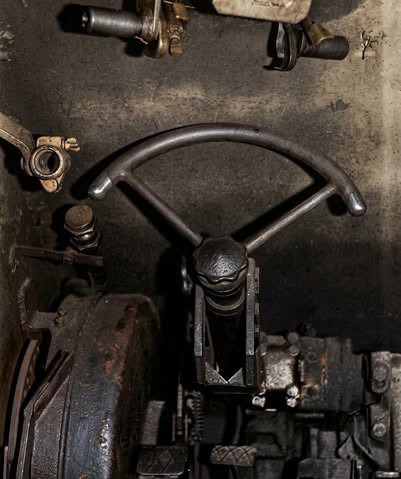
A photograph of a grubby mechanical housing inside the surviving Panther II raises a larger question: how much of what modellers accept as German AFV interior colour is established by surviving evidence, and how much has acquired authority through repetition?
The photograph was taken while the Panther II was at Fort Knox, Kentucky. MAN completed the surviving prototype hull in August 1943. Its distinctive steering wheel draws the eye immediately, but the important detail lies lower down, on the large circular housing beside the steering position.
Under accumulated grime and corrosion, the surface appears distinctly blue-grey. The appearance is worth recording as Blaugrau in the descriptive sense, but the photograph cannot by itself identify the original RAL designation. The vehicle underwent postwar restoration, and the provenance of any surviving coating matters as much as its present colour.
BLUE-GREY
IVORY
RED OXIDE
01 / COLOUR AND LIGHT
The colour we think we see
Colour is inseparable from the light by which it is seen. Daylight, tungsten lamps and LEDs have different spectral characteristics. Camera white balance, image processing and display calibration can shift the recorded appearance still further. A neutral grey can appear cooler or greener without its pigment having changed.
A photograph records the appearance of a surface under particular conditions. It is not a laboratory analysis of its original coating. That standard must apply equally to blue-grey and greenish-grey identifications.
Our previous investigations have considered the Panzer III Ausf. L, early and late Tiger I, Panzer II Luchs, the Sd.Kfz. 234 series, Tiger II prototypes and production vehicles, Panthers and Jagdpanthers, and the MNH vehicles assembled under British supervision in 1945–46. The evidence varies in provenance and quality. What keeps returning, however, is the appearance of blue-grey on lower structural and mechanical surfaces.
David Byrden described original Tiger I radiator-compartment finishes as blue-grey while associating the coating with RAL 7009. Meanwhile, modern RAL 7009 is designated Grüngrau, and modern RAL 7031 is designated Blaugrau. Historical Blaugrau and Fliegerblaugrau colour references require separate examination. A modern name or swatch cannot settle the identity of an aged wartime coating. This study therefore uses modern RAL 7031 only as a fixed visual modelling reference, not as an assertion of wartime paint designation.
02 / THE CROSS-VEHICLE EVIDENCE
Blue-grey across vehicles and production years
The Panther II is not the whole argument. We have examined blue-grey interior appearances in vehicles built years apart, from different production lines, and in compartments serving very different functions. The evidence is strongest where an original surviving coating is documented; elsewhere, the photographs establish an appearance that must be tested against the vehicle’s restoration and production history.
The sequence matters. A wartime blue-grey finish did not appear only in one 1943 prototype and then disappear from the historical discussion. At the same time, no honest comparison can turn every grey surface into one universal RAL number. Blue-grey is the observed family of finishes. Identifying the exact factory paint is a separate task.
1942–43: Panzer III and the original Tiger I evidence
The Panzer III Ausf. L was built from June to December 1942. That establishes an early point on our research timeline. Photographic examples associated with the Ausf. L belong in the comparative colour record, but the exact lower-hull coating on a given vehicle must be traced to its own photograph or physical sample. The production date is secure; a specific paint number is not established merely by naming the variant.
The early Tiger I provides the more substantial paint evidence. David Byrden’s examination of Bovington’s Tiger 131 records original blue-grey paint on radiator equipment, and his survey describes blue-grey finishing in early Tiger engine compartments before the practice changed around mid-1943. Here we have a physical surviving finish, a documented vehicle and a researcher explicitly describing what he examined. The later Tiger I is a useful control: surviving red-oxide areas and known changes in finishing practice prevent us from imposing an early-war colour scheme on every later Tiger.
This is the distinction the article previously missed: the same broad visual colour occurs in a real surviving assembly, while the factory treatment could change with the date and component. That is far stronger evidence than repeating a kit-painting instruction.
1943–44: Panther II, Luchs, Sd.Kfz. 234 and Tiger II
The Panther II hull was completed by MAN in August 1943. The Fort Knox photograph records the lower assemblies as they survived decades later: worn, dark and visibly blue-grey under the photographed illumination. It gives our investigation a compelling point of comparison, not a certified August 1943 paint sample. The restoration and component history remain relevant.
The Panzer II Ausf. L Luchs belongs to the following production period: The Tank Museum records manufacture from September 1943 through January 1944. The archived Luchs references broaden the vehicle comparison, but their colour descriptions must be tied to the specific surfaces and restoration history photographed. The Sd.Kfz. 234 family extends the comparison into the 1943–45 armoured-car programme, rather than another variant of the same tracked chassis. Photographed blue-grey equipment here matters because it crosses both vehicle type and manufacturer; the attribution of any individual finish still demands a traceable original surface.
The Tiger II V2 supplies an unusually precise date: The Tank Museum records its completion by Henschel in December 1943. The museum’s production Tiger II, chassis 280093, was built in July 1944. Both belong in our evidence register because they allow photographic observations to be compared against known construction periods. They are not automatically proof of identical coatings. The distinction between the V2 prototype, July 1944 production and any later conservation treatment is essential.
1944–45: Panthers and Jagdpanthers
Panther Ausf. G production ran through 1944 and into 1945 at MAN, Daimler-Benz and MNH. Jagdpanthers were also produced across that period, with MNH joining the programme in late 1944. The original interior photographs collected for this investigation show blue-grey appearing on structures and mechanical assemblies, at times adjacent to lighter Elfenbein. Those views must be assessed component by component: factory paint, later restoration and discoloured surfaces cannot be collapsed into a single colour identification.
The point is the breadth of the question. We are now comparing different vehicles, factories and production decisions—not matching one old photograph to a commercial paint label. Every example expands the research field; only documented original coatings settle a particular historical application.
1945–46: The MNH vehicles completed under British supervision
The post-surrender Panthers and Jagdpanthers from MNH, Hannover, are especially useful because their assembly history is documented. The Tank Museum identifies its Panther as a vehicle completed under 823 Armoured Troops Workshop, REME. The Weald Foundation records 12 Jagdpanthers assembled postwar under REME supervision and identifies its own wartime Jagdpanther 303086 as built in February 1945. These are traceable objects, not generic photographs of “a late-war Panther.”
They also impose an important boundary. A vehicle assembled from German components after surrender can help reveal late-production construction and finishing practice, but a postwar-applied coating cannot by itself establish a wartime German paint instruction. Each painted area still needs its own provenance. That is why these MNH vehicles strengthen the investigation without being used as a shortcut to an exact RAL attribution.
The evidence register
The following register separates verified production chronology from the strength of the surviving colour evidence. It identifies what each example contributes to the Blaugrau investigation without promoting a visual observation into a factory specification.
| Production period | Vehicle | Established observation or association | Limit of the evidence |
|---|---|---|---|
| 1942 | Panzer III Ausf. L | Factory period verified; photographic blue-grey comparison in research set | Colour identification requires an authenticated, vehicle-specific coating |
| 1942–mid 1943 | Early Tiger I / Tiger 131 | Original blue-grey radiator equipment documented by David Byrden | Strongest direct original-paint example; component-specific |
| Aug 1943 | Panther II prototype | Surviving lower mechanical assemblies appear blue-grey in Fort Knox photograph | Photographic observation; component/repaint history unresolved |
| Sep 1943–Jan 1944 | Panzer II Luchs | Production period verified; archived interior comparisons | Original-coating provenance requires confirmation |
| 1943–45 | Sd.Kfz. 234 family | Independent wheeled-AFV programme in comparative investigation | Photographic observations; not a proven single RAL specification |
| Dec 1943 | Tiger II V2 | Henschel prototype completion date verified | Paint on each photographed surface requires verification |
| Jul 1944 | Henschel Tiger II, 280093 | Individual vehicle and construction month verified | Use dated images; do not assume original from restoration colour |
| 1944–45 | Panthers / Jagdpanthers | Multiple factories and preserved vehicle references | Compare original, aged and restored zones separately |
| 1945–46 | MNH / REME completed Panther & Jagdpanther | British-supervised completion and surviving vehicles documented | Postwar completion is not automatically a wartime paint sample |
What the photographs establish: The archived Fort Knox image, the Tank Museum interior views and the Saumur Tiger photographs show a recurring muted blue-grey appearance across lower compartments, equipment and mechanical structures. They do not all have equal restoration histories. Nor do exposure, flash, tungsten, daylight and camera white balance produce a common colour measurement. A photographed resemblance is useful comparative evidence; a sampled original coating remains the standard for a precise specification.
What the historical registers establish: The documented RAL 840 B 2 No. 4 / RAL 840 R 7016 Fliegerblaugrau reference is a separate, darker-looking historical colour sample. It should not be forced onto these lighter observed interior surfaces by name alone. For the modeller’s working reproduction in this article, modern RAL 7031 is the fixed visual approximation, not the proven wartime factory code.
03 / PUBLICATION AND PAINT
When interpretation becomes a specification
The route from a reference book to a model bench is familiar. An author identifies a colour; a kit manufacturer reproduces it in the painting instructions; a paint company sells the matching bottle. Sponsorship and attractive reference illustrations can lend the interpretation still greater authority.
Yet three appearances of the same claim do not provide three independent pieces of evidence. An author’s interpretation is not an original manufacturing specification, and a paint manufacturer’s callout is not a paint sample taken from a vehicle.
If a surviving finish is described as greenish-grey, the useful question is straightforward: was the identification established by a wartime specification, an authenticated original sample, measured analysis, or a visual comparison conducted under uncertain illumination? The distinction is not pedantic. It is the difference between documenting a colour and repeating a convention.
04 / THE RED-PRIMER CLAIM
Scarcity is not the same as interruption
A similar weakness appears in the familiar claim that late-war German AFV interiors were left in red-oxide primer because the country had run out of paint. The premise sounds plausible. Bombing destroyed industrial facilities, damaged transport networks and interrupted shipments of resins, pigments, solvents and finished coatings.
But a factory missing a scheduled delivery is not proof of universal scarcity throughout German industry. A finishing operation may be omitted because of a local interruption, production simplification, labour pressure or an administrative instruction. Those are different causes and must be documented separately.
The 31 October 1944 directive reproduced by Jentz and Doyle ordered the discontinuation of interior painting at tank assembly firms. That establishes a production instruction. On 23 January 1945, the authorities reinstated Elfenbein in specified upper interior areas. The sequence shows active revision of finishing policy as Germany’s industrial position worsened. It does not establish a single, permanent disappearance of paint from every factory.
Red-oxide primer was real, and so were the orders allowing it to remain exposed. The myth is the blanket attribution of those finishes to an unspecified, universal paint shortage.
THE PRODUCTION LEDGER
INDUSTRIAL OUTPUT / 1944
39,807
LUFTWAFFE AIRCRAFT ACCEPTED
1944 · vs 15,596 in 1942
27,340
ARMOURED VEHICLES
1944 · broad series; 19,824 in 1943
9.1bn RM
AMMUNITION OUTPUT VALUE
1944 · vs 7.4bn RM in 1943
35,000+
V-1 AND V-2 PRODUCED
Combined wartime production estimates
Aircraft figures are acceptance totals; the AFV total uses a broad classification; ammunition is valued in constant Reichsmarks; V-weapons are manufacturing totals, not launches.
05 / THE INDUSTRIAL CONTRADICTION
The production figures demand an explanation
The scale of German production makes the shortage explanation especially demanding. The United States Strategic Bombing Survey reported 39,807 Luftwaffe aircraft accepted in 1944, compared with 15,596 in 1942. A broad armoured-vehicle production series records 27,340 vehicles in 1944 against 19,824 in 1943. Ammunition output value rose from 7.4 to 9.1 billion Reichsmarks at constant prices.
These were not isolated machines emerging from quiet factories. They were products of an industrial system operating under bombardment while still consuming primers, protective coatings, camouflage paints and finishing materials. Operational Luftwaffe aircraft continued to carry camouflage; the bare-metal Me 262 surrendered by acceptance pilot Hans Fay in March 1945 was not a frontline fighter returning from combat.
The V-weapons provide an even sharper comparison. The RAF Museum records at least 29,000 V-1 flying bombs manufactured, and the U.S. Air Force Museum estimates approximately 6,000 V-2 rockets built in 1944–45. More than 22,000 V-1s and about 3,000 V-2s were launched. Production numbers and launch numbers are different measures, but both describe a major late-war programme.
Operational V-1s commonly wore green-and-light-blue camouflage; late-war V-2s carried green finishes documented in historic photographs and surviving coatings. The Smithsonian’s conservation work recovered original green paint traces on its V-2. These were expendable weapons, yet factories still applied paint because camouflage mattered during storage, transportation and preparation for launch.
Expendable weapons. One mission. Yet camouflage continued to be applied.
That production record contradicts the lazy transition from “wartime disruption” to “there was no paint available”. It points instead to selective allocation, local interruptions, manufacturing choices and operational priorities. To attribute an AFV finish to a shortage, identify the factory, coating, date and documented supply failure.
06 / THE HISTORICAL TEST
What the Panther II actually establishes
The Panther II brings the argument back to a specific object. Its 1943 hull predates the emergency directives of late 1944. The lower mechanical housing appears blue-grey in the Fort Knox photograph. That observation is legitimate; identifying the original material requires the same care we should demand from anyone describing the surface as greenish-grey or primer red.
The evidence now stretches from original early Tiger I blue-grey radiator finishes, through the dated 1943 Panther II and Tiger II V2, to the 1944 Luchs, Sd.Kfz. 234 and production Tiger II, the Panther and Jagdpanther programmes, and the traceable post-surrender MNH vehicles. This is a cross-vehicle, cross-manufacturer investigation—not a single preserved exhibit. The historical colour registers provide context; they do not override the observed surface or its provenance.
The evidence must establish the colour. The manufacturing record must establish its application. Documentary evidence must establish the reason for any change.
A colour callout tells a modeller what paint to buy. It does not necessarily tell us what paint the Germans applied. Sometimes the evidence has been sitting in plain sight all along; we have simply become accustomed to seeing what the reference chart tells us to see.
07 / MODELWORX WORKING COLOUR REFERENCE
BLAUGRAU — FIXED RAL 7031 VISUAL TARGET
The master swatch below uses the RAL 7031 reference selected for this article: RGB 93, 103, 109 / HEX #5D676D. It is a practical visual approximation to the blue-grey surfaces observed in the AFV interior photographs. It does not establish the original wartime RAL specification.
COLOUR-VIEWING PROVISO
Night Light, Night Shift and other warm-screen settings alter the displayed colour. Blue-light-filtering prescription or reading lenses can also change its appearance. For meaningful comparisons, disable colour-shifting display modes and assess the swatch on a calibrated monitor under neutral lighting, accounting for any tinted or filtering lenses. Make the final paint judgement from a cured test sample viewed under consistent neutral illumination.
REFERENCE SWATCH / RAL 7031 VISUAL MATCH
One fixed target. Four independent recipes. All four charts use exactly the same sampled master colour. The ratios below are provisional bench starting points; no cured test panels were measured. Do not read the proportional bars as simulations of the final paint.
FOUR PAINT SYSTEMS / MIX RATIO BARS
All swatches below reproduce the same RAL 7031 visual target. The numeric bars show the parts count. They are not digital renderings of mixed pigments.
AK Real Colors
VISUAL TARGET · RGB 93 / 103 / 109
Paint proportions — 5:2:1 | 8 parts total
5
2
1
5 parts / RC923 M-485 Blue Grey
2 parts / RC912 Grey FS 36081
1 part / RC908 Intermediate Blue FS 35164
Ratio-bar tones indicate quantities only, not the resulting mixture colour.
AK 3G Acrylics
VISUAL TARGET · RGB 93 / 103 / 109
Paint proportions — 5:2:1 | 8 parts total
5
2
1
5 parts / AK11165 Grey-Blue
2 parts / AK11022 Dark Grey
1 part / AK11163 Intermediate Blue
Ratio-bar tones indicate quantities only, not the resulting mixture colour.
Tamiya XF
VISUAL TARGET · RGB 93 / 103 / 109
Paint proportions — 4:2:2 | 8 parts total
4
2
2
4 parts / XF-24 Dark Grey
2 parts / XF-18 Medium Blue
2 parts / XF-19 Sky Grey
Ratio-bar tones indicate quantities only, not the resulting mixture colour.
Tamiya LP
VISUAL TARGET · RGB 93 / 103 / 109
Paint proportions — 4:3:1 | 8 parts total
4
3
1
4 parts / LP-36 Dark Ghost Gray
3 parts / LP-27 German Gray
1 part / LP-78 Flat Blue
Ratio-bar tones indicate quantities only, not the resulting mixture colour.
APPLICATION: Parts are paint quantities only. Thinning and atomisation remain the modeller’s decision. Match the fully dried finish to the fixed visual target under controlled illumination.
STATUS: Mixing proportions are working hypotheses, not verified colour-matched formulas. The swatches are the target, not asserted photographs of the mixed results.
SOURCE NOTES
Documentation and further reading
Panther II prototype: Preserved Tanks — Panther II.
German aircraft acceptance totals: U.S. Strategic Bombing Survey, Summary Report (European War).
Broad German armoured-vehicle production series: Deutsche Rüstungsproduktion 1939–1945.
Ammunition output values: University of Calgary archival study, “German Munitions Output, 1940–1944”, Table 5.2.
V-weapons: RAF Museum, Fieseler Fi 103; National Museum of the U.S. Air Force, V-2 Rocket.
Original missile finishes: Smithsonian National Air and Space Museum, V-1 restoration and V-2 restoration.
AFV painting directives: Thomas L. Jentz and Hilary L. Doyle, Germany’s Tiger Tanks: VK45.02 to Tiger II, section 6.3.4.4.
Original Tiger I blue-grey paint: David Byrden — Tiger radiators; lower fuel tanks; interior paint changes.
Variant chronology: The Tank Museum — Panzer III Ausf. L; Luchs; Tiger II V2; July 1944 Tiger II.
Panther and Jagdpanther production context: Panther factory production; Jagdpanther production by factory.
Postwar MNH/REME completion: The Tank Museum — Panther; Weald Foundation — Jagdpanther 303086 and postwar 303110.
Photography note: archived German AFV interior photographs from the research Library are comparative visual material. Individual images require source and restoration-history checks before being represented as original factory paint.