TRUTH • PEOPLE • PLACES
A STRONGER TOMORROWMALTA • ITS PEOPLE
ITS STORIES LIVE ON
THE MEDITERRANEAN CHRONICLE
MONDAY MUSE / A WARTIME LOVE STORYRETROSPECTIVE EDITION — 2026
THE MYSTERY OF THE MISSING ACE
The woman who loved him. The sky that took him.
Malta, 1941. In the shadow of siege, an RAF reconnaissance pilot and a celebrated performer found each other.
She served Malta in its secret operations rooms and earned the British Empire Medal.
On 12 April 1944 Adrian disappeared over Germany. He never came home.
Christina died in 1988, without learning where her Warby lay.
In 2002, an answer arrived. It came fourteen years too late.

“The war ended.
Her waiting did not.”
MALTA · LOVE, LOSS & THE YEARS BETWEEN
THE WOMAN WHO WAITEDLOVE • DISTINCTION • THE YEARS BETWEEN
CHAPTER I / MALTA, 1941
An Island Beneath the Bombs
At night, Malta belonged to shadows. The blackout drew curtains across windows and turned familiar streets into corridors of uncertainty. Out beyond Valletta’s limestone walls, the harbour held the dark shapes of ships; above them, the sound of aircraft could scatter an evening’s fragile peace in an instant. And yet the island lived. Music still found its way into crowded rooms. People danced because the future was uncertain, not because they had forgotten it was.
Christina Ratcliffe had come to Malta with the gifts of a performer: presence, grace, quick intelligence and the instinct to lift an audience beyond its surroundings. In the clubs associated with Strait Street, she discovered a world where laughter and fear sometimes occupied the same hour. With the Whizz Bangs concert party, she entertained men whose work took them to airfields, ships, batteries and the defences of an island under siege.
Adrian “Warby” Warburton belonged to another part of that extraordinary world. He flew reconnaissance missions where the value of a camera could be greater than that of a gun. Daring, unpredictable and immensely skilled, he developed a reputation for bringing back photographs from places where an aeroplane had little business surviving. His courage was not quiet. It was restless and at times infuriating; but Malta learned to recognise the young pilot who so often returned from the impossible.
They met in Floriana on 24 January 1941. The precise words they spoke belong to them alone. What followed became part of the island’s wartime memory: the daring aviator and the beautiful, spirited woman who refused to let the war extinguish her love of life.

FROM THE ARCHIVE
More than a wartime romance
The photograph matters because it returns these people to us. There is nothing theatrical about the simple fact of their being together: a young man in uniform, a woman beside him, and a moment that endured on paper long after their shared life was over.
What the camera cannot reveal is the work Christina would do beneath the island’s fortifications, or the cruel distance that would eventually separate them. For that, we have to look beyond the romance and recognise the substance of the woman herself.
CHAPTER II / COURAGE AND DISTINCTION
A Dangerous Man. A Remarkable Woman.
It would be easy to tell Christina’s story as the tale of a glamorous woman who loved a celebrated pilot. It would also be a disservice. Her beauty was unmistakable, but beauty alone cannot explain her place in Malta’s history. She was talented enough to command an audience, resilient enough to stay on an island under bombardment and capable enough to shoulder responsibility in one of its most demanding operational environments.
The stage offered one kind of courage. To perform while war pressed upon the doors required defiance of its own. A song could restore something ordinary to men who had forgotten what ordinary life sounded like. Christina understood the value of that gift. But she wanted to do more than entertain, and she volunteered for work connected with the Royal Air Force.
She began as a telephonist and became a civilian aircraft plotter at the underground Lascaris War Rooms, beneath Valletta’s fortifications. There, aircraft movements had to be tracked and understood as reports reached the operations centre. Plotting demanded speed, clarity, a disciplined eye and the ability to remain composed when the information being received meant lives could be in immediate danger. In that compressed, pressured world, a careless mark or a moment’s hesitation mattered.
Christina proved herself. She became Captain of D Watch and later served as an Assistant Controller. These were responsibilities within the operations organisation, not ornamental titles. Their significance lies in the trust they represented: colleagues and superiors relied upon her judgement in a place where competence was indispensable. In June 1943 her service received formal recognition with the British Empire Medal, Civil Division. The official award notice named her as a plotter in the Operations Room at RAF Headquarters, Malta.

Her beauty could fill a room. Her intelligence, courage and ability earned her a place in the defence of Malta.
One may admire the elegance of her photographs and still recognise that the more remarkable story lies beyond the lens. Christina was an artist and an operational professional, a woman of warmth and discipline, public charm and private resolve. These qualities do not compete with her beauty; they deepen it. In Adrian, she had met a man who lived on the edge of danger. In Christina, he encountered someone whose own courage was entirely real.
CHAPTER III / A FORBIDDEN TENDERNESS
A Love in Malta
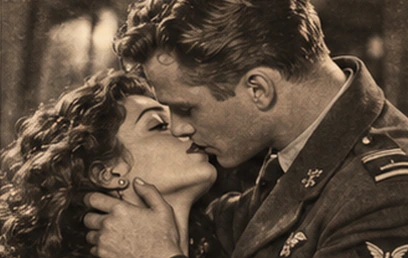
War does not simplify the heart. Warburton had married Eileen Mitchell before the conflict, and the marriage was troubled. The presence of that marriage belongs in any truthful account of his relationship with Christina. Yet neither their complicated circumstances nor the brevity of their time together makes the affection that grew between them less human. It makes their story more fragile, with happiness always liable to be interrupted by duty, distance and choices for which there were no easy answers.
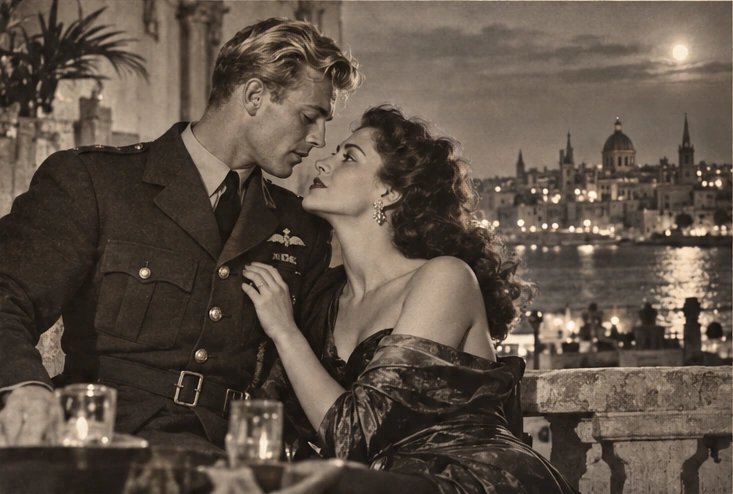
Imagine the island after the last performance of the evening: the music exhausted, the streets darkened, the air still carrying the day’s heat from its limestone walls. Somewhere a door shuts, somewhere a harbour light disappears, and two people make a small sanctuary of one another’s company. Such scenes are the language of romantic imagination, not recovered eyewitness accounts. But they suggest why moments of tenderness might have felt immeasurably precious when tomorrow could make them impossible.
For Christina, the admired pilot was also the man behind the uniform: impulsive, charming, exasperating, capable of great bravery and ordinary need. For Adrian, the glamorous performer was a woman who understood danger without surrendering her spirit to it. There was wit as well as attraction in such a pairing, an equality of vitality that makes the remembered romance more than a story of a hero and his admirer.
The war surrounded them, but it did not own every hour. The island offered its terraces, its music, its stubborn humour and its Mediterranean light. Their relationship became a private counterpoint to the public drama, celebrated by those who knew them and shadowed always by the knowledge that there could be no promise of an ordinary future.
The war ended. Her waiting did not.

CHAPTER IV / THE LAST GOODBYE
The Words History Never Kept
The little paper keepsake pictured here is invented. Its handwriting is not Warburton’s, and its tender promises come from imagination rather than an archive. It belongs nevertheless to the emotional truth of the story: the desperate wish to say what matters before there is no longer time.
In October 1943 Adrian left Malta. Christina never saw him again. No later meeting softened their separation into the familiar rituals of shared life. The passing of the war took them into different worlds, and the woman who remained on the island could do little but hope that distance was temporary.
On 12 April 1944, Warburton flew a photographic reconnaissance mission over southern Germany in a Lockheed F-5B Lightning. He did not return. The world that knew his daring had no answer to the silence. For Christina, the absence was not a historical mystery to be solved in a future decade. It was personal and immediate: there would be no unexpected appearance at the doorway, no easy return to the life they had imagined.
THE AIRCRAFT THAT NEVER RETURNED
A camera instead of guns
Warburton disappeared on a photographic reconnaissance flight in a Lockheed F-5B Lightning, serial 42-67325. The reconnaissance aircraft carried cameras in place of the fighter’s usual nose guns. For a modeller, it is a poignant subject: the aeroplane in which Adrian flew away from Christina’s world for the last time.
CHAPTER V / THE YEARS BETWEEN
The Woman Who Remained
Peace arrived by degrees. Ships came and went without the urgency of convoy alarms. Streets filled again with ordinary sounds. Men returned to families who had waited by windows and counted the months. Malta began to breathe beyond the demands of survival. Yet the end of fighting did not resolve every loss, and official silence offered little comfort to those whose loved ones had simply disappeared.
Christina stayed on the island. It was the place in which she had discovered fame, danger, purpose and love; the place where she had given her abilities to a cause larger than herself. It could never be reduced to the background of a romance. Her work in the operations rooms and the fellowship of wartime Malta remained part of who she was, alongside her stage career, writing and personal relationships.
We must be careful with the word waiting. It is a beautiful word for a newspaper headline, but an incomplete description of a human life. Christina did not cease to be an intelligent, gifted and accomplished woman because Adrian vanished. She had already demonstrated the strength to endure bombardment, to serve under pressure and to find a purpose far beyond the footlights. The tragedy is not that she did nothing but wait. The tragedy is that one essential answer was withheld from her while life continued.
There must have been mornings when the harbour looked almost unchanged, and evenings when its lights suggested the glamour of a world they had known together. What private meaning Christina gave to such moments cannot be recovered. We know the events; we do not possess the full map of her heart. Perhaps that uncertainty is why the story stays with us. It leaves a place for compassion without allowing us to claim knowledge that belongs to no one now.

MALTA · AFTER THE WAR
The same sea. A different silence.
The sea endured. The limestone terraces held the warmth of evening. The war had passed into memory, and the future belonged to those still living. But somewhere beyond Malta lay the answer to a question Christina would never see resolved.
In 1988 she died on the island, aged seventy-four. She had never married. Whatever peace or sorrow belonged to the last years of her life must not be invented for her. It is enough to know that the fate of the man she loved remained uncertain.
CHAPTER VI / FIFTY-EIGHT YEARS TOO LATE
The Answer That Arrived Too Late
The aeroplane had not vanished into legend. Its remains lay in Bavaria, beneath the ground of a country remade by the decades after the war. In 2002, investigators recovered the wreckage and established the identity of the missing pilot. A question that had endured for fifty-eight years finally received its answer.
On 14 May 2003, Wing Commander Adrian Warburton was buried with military honours at Dürnbach Commonwealth War Cemetery in Germany. His widow attended the ceremony. There were veterans and representatives of a world that had once known his name, now gathered to restore dignity and certainty to an unfinished account.
Christina was not there. She had died fourteen years before the wreckage was discovered. The discovery could close the historical record; it could not reach backwards to comfort the woman who had spent so much of her life without knowing.
There is something almost unbearable about this timing, though nothing needs to be exaggerated. A man was lost in 1944. His fate was established in 2002. The woman who had loved him died in 1988. These simple facts are more moving than anything that could be written to embellish them.
CHAPTER VII / A LOVE WITHOUT FAREWELL
Where the Light Falls on Malta
Imagine Malta at the close of day. The sea grows dark beyond the bastions; a last warmth clings to the stone. The sky no longer belongs to the aeroplanes that once divided every hour between danger and relief. It is simply evening, and people are going home.
The young pilot and the celebrated performer belong now to photographs and remembered names. Their romance has been told through fragments: a meeting, a shared island, an interrupted future, the work each did while the world was at war. The photographs preserve faces; the archives preserve dates. Between them lies the part of love that no document can entirely hold.
Christina deserves remembrance not only as the woman Adrian Warburton loved, but as the artist who carried music into a besieged city and the capable, decorated worker who served its defence. To recognise her whole life is not to diminish the romance. It is to understand why its loss matters.
History eventually found its missing aviator. It could not give back the years, or place a last farewell into the hands of the woman who might have treasured it. Somewhere in that distance between a discovered fact and an impossible reunion is the enduring sadness of their story.
The war ended.
Her waiting did not.
From the Archives
24 January 1941: Adrian and Christina meet in Floriana. 1943: Christina receives the British Empire Medal; Adrian leaves Malta in October. 12 April 1944: Adrian disappears on reconnaissance over Germany. 1988: Christina dies in Malta. 2002: Warburton’s remains are identified. 14 May 2003: He receives a military burial at Dürnbach.
Historical references: Times of Malta — Malta’s wartime heroines; Times of Malta — A love story in the midst of war; Malta Aviation Museum; RAF Photographers Memorial; Paul McDonald’s research on the women of Lascaris and Christina’s operations work; and the 4 June 1943 London Gazette notice of her BEM.
Editorial and image note: This is a modern romantic historical retrospective, not a genuine period newspaper. The terrace portraits, solitary harbour scene, bookend portraits and memorial illustration, and illustrated letter are artistic interpretations; the letter is fictional and is not archival correspondence. The aircraft photograph shows a representative period Lightning, not Warburton’s own machine. The archival Adrian-and-Christina photograph is understood to date from the early 1940s; original photographer unidentified. Photographs from that period are generally public domain in Canada, although other jurisdictions can differ.
THE MEDITERRANEAN CHRONICLE / A LIFE · A LOVE · A FAREWELL
DANGEROUS SKIES
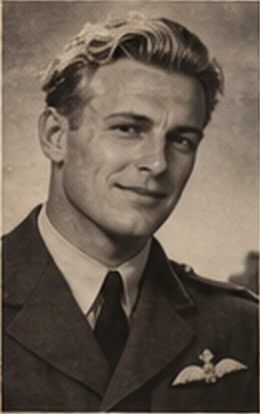
Wing Commander Adrian “Warby” Warburton (1918–1944) became one of the RAF’s most daring reconnaissance pilots. His missions above enemy territory brought exceptional distinction. On 12 April 1944 he departed in an F-5B Lightning and never returned. For decades, no one could tell Christina where he lay.
A REMARKABLE WOMAN
Christina Ratcliffe was an English cabaret performer whose intelligence and courage matched her striking beauty. She entertained servicemen during Malta’s siege, served as an aircraft plotter at the Lascaris War Rooms, advanced to positions of responsibility and received the British Empire Medal in 1943. She died in Malta in 1988 without knowing Adrian’s fate.
A FINAL REST
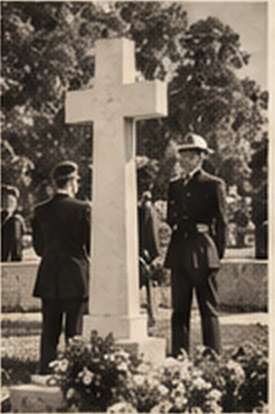
In 2002, fifty-eight years after his disappearance, Warburton’s aircraft was discovered in Bavaria and his remains identified. He was buried with military honours at Dürnbach on 14 May 2003; his estranged wife attended. Christina had died fourteen years before the discovery. History found its missing pilot. The woman who loved him never received the answer.
© James “Doc” Wooldridge — Human-Directed Agentic Engineering