

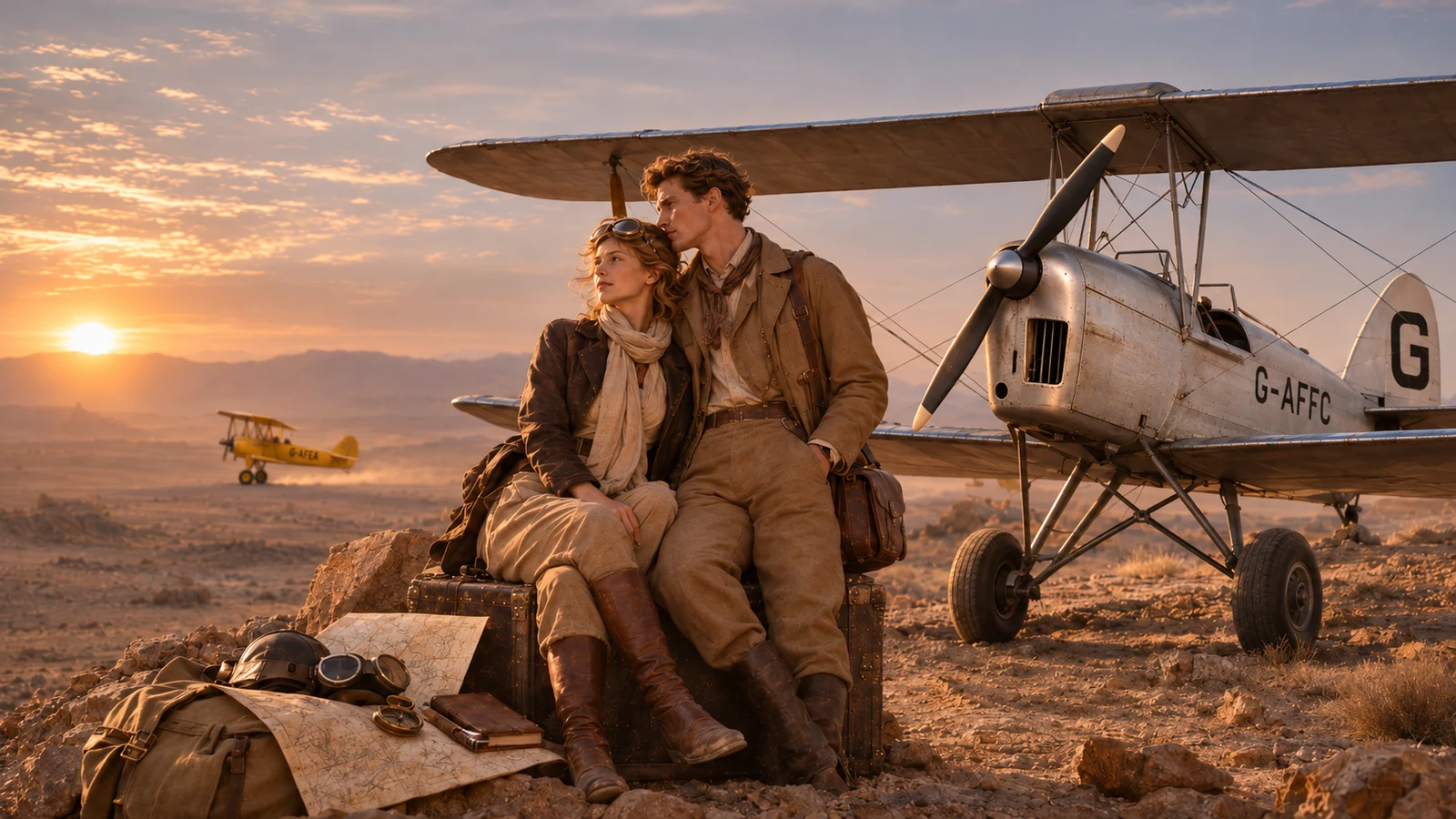
Saturday Muse · History / Cinema / Aviation
Kawartha Scale Modellers · A Saturday Muse Feature
Forbidden Love, Wings & Tragedy
The Real-Life English Patient Story
Some love stories are written in ink. Others are written in the sands of history, where time slowly erases the footprints of those who dared to dream, to love and to venture beyond the ordinary. Sometimes, the boundary between truth and fiction becomes as elusive as the desert horizon itself.
The Fiction and the Real Lives Behind It
In 1992, Canadian novelist Michael Ondaatje gave the world The English Patient, a haunting tale of forbidden love, betrayal, war and devastating loss. Four years later, Anthony Minghella transformed the novel into a magnificent film, with Ralph Fiennes and Kristin Scott Thomas portraying two lovers whose passion would ultimately consume them.
Against the immense, unforgiving emptiness of the North African desert, the married Katharine Clifton falls desperately in love with the mysterious Hungarian explorer, László Almásy. Their secret affair becomes a tumult of desire, jealousy and guilt, culminating in a shattered aircraft, a dying woman hidden in a desert cave and a love that neither war nor death can entirely extinguish.
It is a heartbreaking work of fiction. Yet behind Ondaatje’s imagined tragedy lies another story, involving real explorers whose brief lives, shared ambitions and untimely deaths possess a poignancy requiring no embellishment.
Robert and Dorothy Clayton-East-Clayton
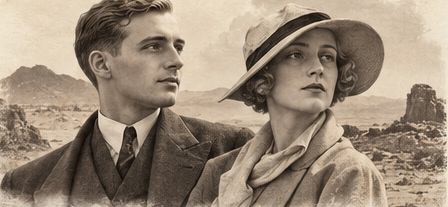
Married on 29 February 1932, Sir Robert Clayton-East-Clayton, a young Royal Navy officer, and Dorothy Mary Durrant, a talented sculptor and aviator, were two adventurous spirits seemingly destined for an extraordinary life together.
Sharing an enthusiasm for exploration, they joined the real László Almásy on a 1932 expedition into the Libyan Desert, searching for Zerzura, the legendary lost oasis. Imagine the excitement of these newlyweds: ancient maps, fragile aeroplanes, endless expanses of sand and the irresistible possibility of discovering something the world had forgotten.
They had found love, and together they had found a dream worth pursuing. But life, with its extraordinary capacity for cruelty, would grant them precious little time to enjoy either.
A marriage cut heartbreakingly short
Following the expedition, Robert became gravely ill. On 1 September 1932, scarcely six months after their wedding, he died from poliomyelitis at just twenty-four years of age. Dorothy was suddenly a widow, left to contemplate a lifetime without the young husband with whom she had imagined sharing so many adventures. The dreams they had carried into the desert remained unfinished, their future together reduced to memories of a brief marriage and a journey whose promise had once seemed limitless.
Yet Dorothy possessed a remarkable determination. Rather than surrendering the dream they had shared, she resolved to complete the exploration they had begun together. In 1933, she returned to North Africa, travelling once more through landscapes that must have awakened powerful memories of Robert. Perhaps the expedition offered her something grief had taken away: a purpose, a connection, a way of keeping a small part of their marriage alive.
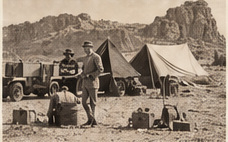
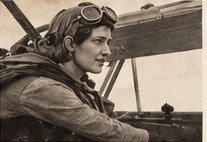
“After my husband’s death I determined to finish the work of discovery we had begun.”
Lady Dorothy Clayton-East-Clayton · Posthumous account in The Times, 16 September 1933
The final, cruel coincidence
On 15 September 1933, at Brooklands aerodrome in Surrey, Dorothy suffered fatal injuries in an accident involving her moving Spartan Arrow aircraft. She was only twenty-seven. The woman who had ventured into the formidable Sahara and returned to complete her husband’s unfinished work had lost her life on an English aerodrome.
In one of history’s most poignant coincidences, The Times published her own account of the desert expedition the following morning. Her words, carrying the determination that had led her back into the wilderness, reached readers only after her death. The newspaper recorded that her account had arrived the previous afternoon, shortly after the accident.
There is a terrible sadness in that coincidence: two young lives, one extraordinary marriage, a shared dream that outlived its dreamers. All that remained were the expedition records, the photographs and the testimony of a young woman who refused to abandon what she and her husband had begun.
From Screen to Scale
The forbidden romance between Katharine Clifton and Almásy belonged to Ondaatje’s imagination. There is no documented affair between Dorothy and the real Almásy, nor did Robert deliberately crash an aeroplane in a jealous rage. Those events are literary fiction, skilfully woven around historical personalities and the extraordinary world of desert exploration.
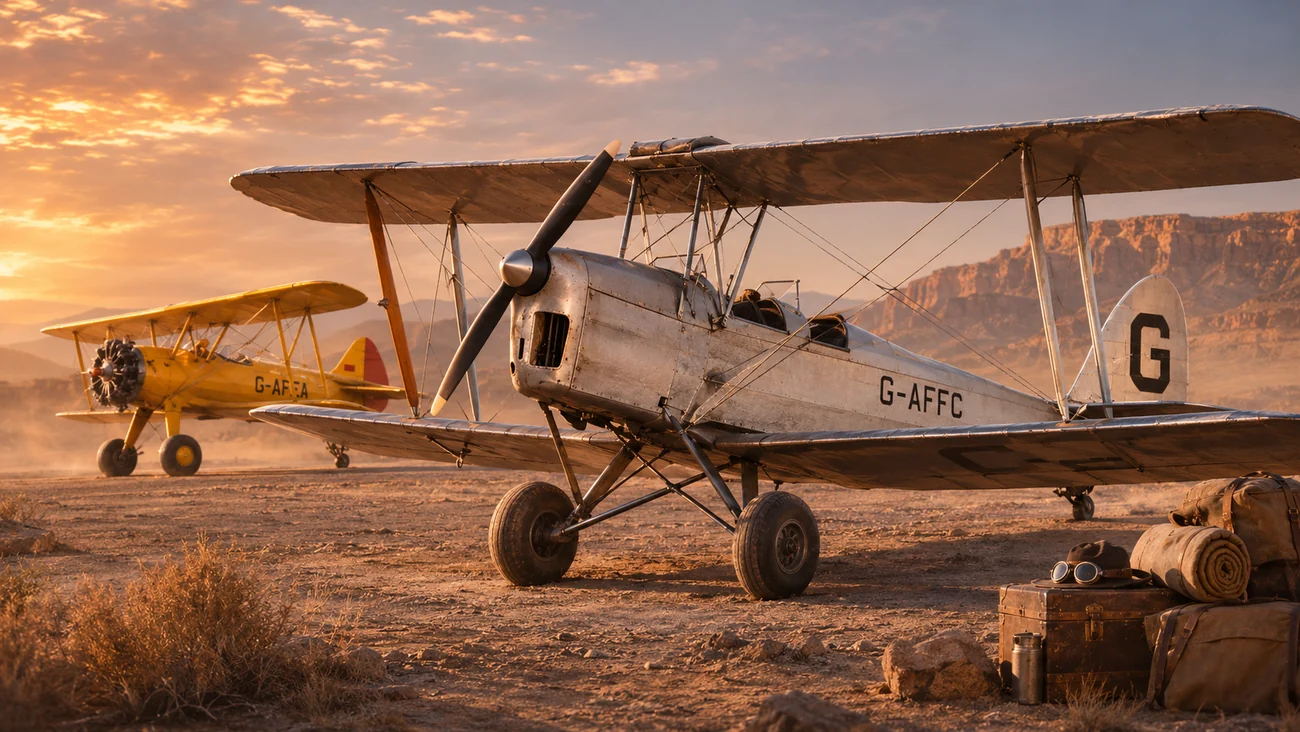
And here our Saturday Muse finds its connection to the modeller’s bench. ICM offers a 1:32-scale twin-aircraft kit, No. 32053, The English Patient, depicting the de Havilland DH.82A Tiger Moth and Boeing-Stearman Model 75 in their film appearances. The silver-grey Tiger Moth and golden-yellow Stearman recall the film, rather than the particular aircraft used by the historical Clayton expeditions.
For the modeller, an aeroplane need not be merely an assembly of wings, rigging, struts and an engine. Sometimes the research reveals something far more meaningful than a paint scheme. It reveals the people who flew, the dreams they pursued and the grief that accompanied their absence.
Saturday Muse · The final reflection
One love story was imagined.
Another was lived.
Ondaatje imagined a forbidden passion destroyed by jealousy and war. History remembers a devoted husband and wife whose love was given scarcely enough time to begin, yet whose shared ambition endured beyond the grave—if only for a little while.
Both remind us of the things left unfinished, the words never spoken and the tomorrows that never arrive.
One story was written. Another was lived.
SATURDAY MUSE · KAWARTHA SCALE MODELLERS · HISTORY, HUMANITY & THE MODELLER’S IMAGINATION
Editorial illustrations are interpretive; historical events are identified separately from the film’s fiction.
Historical references
Christie’s, The Lost Oasis of Zerzura: expedition photograph album · Lady Dorothy’s posthumous account, The Times, 16 September 1933 · ICM 32053 kit information.
