

The Airbrushing Learning Curve: From Anxiety to Muscle Memory
Anxiety, tension, breath holding, and the moment muscle memory takes over.
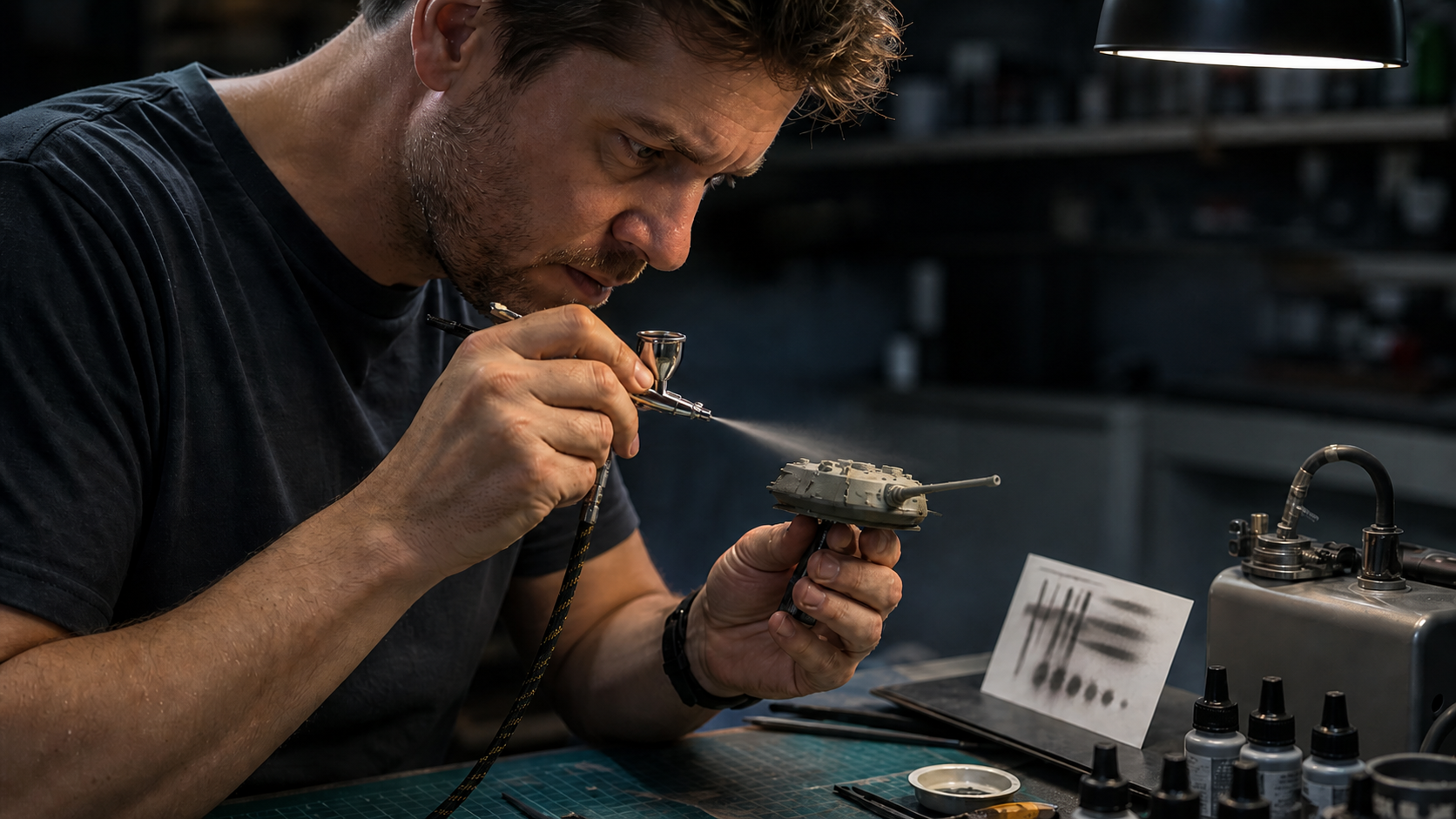
Airbrushing is hard because it is not one skill.
It is several precision skills happening at the same time, under pressure, with very little room for error.
A brush gives direct contact. A pencil gives resistance against the paper. A knife blade gives tactile feedback through the hand. An airbrush gives almost none of that. The tool floats above the surface, and the result appears through an invisible chain of air, paint, distance, angle, movement, thinning, surface condition, and trigger control.
Core Doctrine: The modeller is not just painting. The modeller is trying to control an invisible system.
The Anxiety Comes From Uncertainty
The anxiety is real. It comes from the brain trying to manage too many variables before those variables have become automatic.
The Beginner’s Mental Stack
- Is the paint too thin?
- Is the air too strong?
- Am I too close?
- Am I moving too slowly?
- Will it spider?
- Will it pool?
- Will the line blow out?
- Will I ruin the model?
That stack of uncertainty creates tension in the hand, wrist, shoulder, neck, jaw, and breathing. The body braces for failure before the paint even hits the surface.
That is why so many people hold their breath. Breath holding is the body trying to freeze movement. The brain thinks, “If I stop everything, I will be more accurate.” But airbrushing does not work that way.
Failure Mode: A frozen body does not create control. It creates rigidity. The hand stiffens, the wrist locks, the trigger finger becomes clumsy, and the pass becomes hesitant. Airbrushing punishes hesitation.
The Airbrush Demands Coordination
A double-action airbrush requires several things to happen together: air control, paint control, hand movement, distance control, and surface reading.
Air Control
Air begins the sequence. It stabilizes the spray pattern before paint is introduced.
Paint Control
Paint must be fed, not dumped. The trigger finger has to meter flow independently.
Surface Reading
The modeller must read sheen, wetness, edge quality, and coverage as the surface develops.
The trigger finger must move independently from the hand. The hand must move smoothly while the finger meters paint. The wrist must stay loose. The shoulder must not drive the whole movement like a club. The eyes must read the surface as the paint develops.
Most new users treat the airbrush like a tiny spray can. That is the first mistake. A good airbrush is closer to a musical instrument, a fountain pen, or a precision cutting tool. It responds to tiny movements and exposes hesitation immediately.
The difficulty is not that the tool is mysterious. The difficulty is that the tool is honest.
Tension Creates the Failures the Modeller Is Trying to Avoid
The cruel part is that tension creates the very mistakes the modeller fears.
- A tense hand moves unevenly.
- A tense trigger finger dumps paint instead of feeding it.
- A tense wrist creates hooks, blobs, and stop-start marks.
- A tense shoulder turns fine control into brute movement.
- A tense breathing pattern destroys rhythm.
The airbrush rewards flow. It rewards relaxed repetition. It rewards a controlled sequence, not fear.
That is why the first real battle in airbrushing is not the paint. It is the body.
The Sequence Must Become Automatic
The core sequence is simple, but it has to become automatic before the modeller can relax.
air on → move → paint on → paint off → keep moving → air off
At first, the modeller has to think through every part of that sequence. That is mentally exhausting.
The brain is trying to command the finger, the hand, the wrist, the breathing, the distance, the paint flow, and the surface read all at once. That is where the anxiety comes from. The modeller is trying to think through movements the hand has not yet learned.
Before Muscle Memory, the Airbrush Feels Like a Threat
Before muscle memory, the airbrush feels dangerous. Too many variables. Too much consequence. Too much fear of ruining the surface.
Every pass feels loaded. Every movement feels overthought. The model becomes the battlefield, and the modeller starts performing under pressure instead of practicing with purpose.
Diagnostic Indicator: Breath holding, clenched hands, stiff shoulders, trigger panic, and hesitation are not signs that the modeller lacks talent. They are signs that the body has not yet learned the job.
After Muscle Memory, the Tool Becomes Readable
After muscle memory begins to form, the same airbrush becomes readable. You stop guessing. You stop hoping. You start seeing.
The spray pattern tells you what is happening. The surface sheen tells you if you are too wet. The edge tells you if you are too close or too far away. The trigger tells your finger where the paint begins. The MAC valve gives the hand finer command over air volume. The test card becomes a diagnostic instrument instead of a scrap of plastic.
The airbrush stops feeling like a dangerous little machine. It starts behaving like an extension of the hand.
That is the turning point: the airbrush stops being a threat and becomes a readable instrument.
Test Cards Are Not Optional
Practice away from the model matters. Test cards are not childish. They are calibration.
They remove the fear of ruining the subject and allow the body to learn without consequence. Lines, dots, fades, mottling, edge control, trigger starts, trigger stops, and translucent passes build physical literacy.
TechNote: The model is not the place to learn basic control. The model is where practiced control is applied. A modeller who skips drills transfers the learning curve directly onto the finished subject.
The Real Problem Is Usually Not Talent
Most people think they are bad at airbrushing. Usually, they are not bad. They are under-trained.
- They have not built enough trigger memory.
- They have not practiced distance control.
- They have not learned how thin paint behaves.
- They have not developed surface-reading skills.
- They have not repeated the same movement enough times for the body to trust itself.
So every pass feels like a gamble. That gamble feeling is what creates anxiety. Practice removes the gamble.
Muscle Memory Turns Anxiety Into Control
Airbrushing becomes stressful when the modeller is trying to think through movements the hand has not yet learned.
Muscle memory changes that. The sequence becomes automatic. The body stops bracing. The hand loosens. The breathing returns. The trigger finger becomes more independent. The modeller begins to manage paint, air, distance, and movement without conscious panic.
That does not mean the airbrush became easier. It means the modeller became calibrated.
Bench Standard
Airbrushing is not magic. It is a controlled physical skill.
The bridge between knowledge and skill is practice.
The bridge between skill and mastery is time.
Until muscle memory develops, airbrushing feels tense because the brain is doing too much live calculation. Once muscle memory takes over, the body manages the fundamentals automatically, freeing the mind to focus on finish quality, surface response, and artistic intent.
Airbrushing becomes control when the hand finally knows what the mind has been trying to explain.
Frequently Asked Questions
Common questions about airbrushing anxiety, breath holding, trigger control, and the role of muscle memory.
Why is airbrushing so hard for beginners?
Airbrushing is hard for beginners because it requires several skills at the same time: trigger control, air control, paint flow, hand movement, distance control, and surface reading. Until those movements become automatic, the brain has to think through every step, which creates tension and uncertainty.
Why do people hold their breath while airbrushing?
People often hold their breath while airbrushing because the body is trying to freeze movement and become more accurate. The problem is that breath holding usually creates stiffness, making the hand, wrist, and trigger finger less controlled.
What causes airbrushing anxiety?
Airbrushing anxiety usually comes from uncertainty. The modeller is worried about spidering, pooling, overspray, paint blowing out, or ruining the model. That fear makes the body tense, which often creates the exact mistakes the modeller is trying to avoid.
How does muscle memory improve airbrushing?
Muscle memory improves airbrushing by making the core sequence automatic: air on, move, paint on, paint off, keep moving, air off. Once the hand learns that rhythm, the modeller can focus on surface response and finish quality instead of consciously managing every movement.
Are test cards useful for airbrushing practice?
Yes. Test cards are essential because they let the modeller practice lines, dots, fades, mottling, trigger starts, trigger stops, and paint control without risking the model. They turn practice into calibration.
Is airbrushing difficult because of lack of talent?
Usually, no. Most airbrushing difficulty comes from under-training, not lack of talent. The hand needs repetition before it can control the airbrush confidently. Practice removes the gamble.
