Kawartha Scale Modellers | FAQ Dossier
Masks, Markings, and Airflow Control FAQ
Tamiya masking tape, ORAMASK 810 vinyl, lacquer versus water-based acrylic, and why the MAC valve changes everything.
This document is the bench companion to the full article. Read it top to bottom once. After that, jump straight to the question that matches the failure in front of you. The goal is not inspirational masking. The goal is repeatable masking.
Frequently Asked Questions
A native Gutenberg drop-down accordion block for masking, markings, and airflow control. Paste this into the WordPress code editor and replace, remove, or expand any question as needed.
What actually causes paint bleed under a mask?
Paint bleed requires three conditions at the same time: a gap, airflow energy, and a mobile paint film. Remove any one of those and the failure stops.
Is paint bleed mainly a tape problem?
Usually not. Tape matters, but most failures are process failures wearing a materials costume. The edge was sprayed too wet, the airflow was too aggressive, the angle was wrong, or the base coat was not ready.
Why is Tamiya masking tape the general-purpose benchmark?
It gives the modeller a broad operating envelope: thin profile, strong conformability, clean release, and forgiving behaviour under layered masking and lacquer work.
When does ORAMASK 810 outperform Tamiya tape?
When the job is driven by geometry: hard-edged stars, Balkenkreuze, tactical symbols, serials, and repeatable stencil work where precision outranks flexibility.
Why is lacquer harsher on masks than water-based acrylic?
Lacquer atomizes finer, stays mobile at the edge longer, and can bite into the underlying layer. It rewards control and punishes sloppy edge energy.
Why does regulator PSI not tell the full story?
Because the mask edge does not care what the regulator says in theory. It cares about the airflow energy arriving at the nozzle in that moment.
What does a MAC valve change?
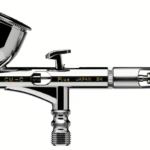
It changes delivered airflow at the brush while the supply remains stable. That lets you starve the mask edge of destructive energy without wrecking the rest of the setup.
What is the simplest bench rule to remember?
If solvent cannot escape, it will migrate. If airflow is not controlled, the tape choice becomes secondary very quickly.
Film Build and Markings FAQ
Why can sprayed markings still look as thick as decals?
Because sprayed markings are still built from physical paint films. Multi-colour insignia create stacked layers, and if each colour is applied too wet or too heavily, the result is a visible step just like a decal edge.
What is the connection between silvering and paint-step buildup?
Both are film-management failures. Silvering comes from trapped air under decal film. Paint-step buildup comes from excessive paint film accumulating on the surface.
What is the correct goal when spraying markings?
Not brute opacity. The goal is low-build opacity: enough colour strength to read correctly, with the least possible thickness left behind.
What is the real quality test for a painted marking?
View it under raking light or macro photography. If it reads like a raised patch, coin, or topographical step, the film build was too heavy.
Why do airbrushed markings usually look more authentic than decals?
Because they are paint behaving like paint, sharing the same surface character, reflectivity, and optical response as the surrounding finish. Decals can reproduce artwork cleanly, but they remain an applied film attempting to impersonate paint.
Kawartha Scale Modellers | FAQ Dossier
Photo-Etch Mask FAQ
A matching drop-down accordion block for photo-etch masks used on vehicle markings, tactical symbols, and national insignia.
What is a photo-etch mask actually doing?
A photo-etch mask acts as a precision stencil rather than a seal. It sits fractionally above the surface and creates a controlled painted edge through spacing, airflow, and restrained paint application rather than adhesive contact.
Why use a photo-etch mask instead of a decal?
Because a painted marking can read as part of the vehicle surface rather than an applied film. Used properly, a photo-etch mask helps create a marking with subtle painted authority and authentic edge character that decals struggle to equal.
What kinds of markings suit photo-etch masks best?
They work best for national insignia, tactical numbers, formation symbols, and recognition markings where a slight painted softness improves realism rather than harms it.
Why can photo-etch mask results look more authentic than hard vinyl masks?
Because the slight standoff can create a subtle edge character that feels painted rather than graphically printed. That can be visually closer to real field-applied markings than the hard, mechanical edge associated with decals or rigid film masks.
What usually causes a poor result with a photo-etch mask?
Too much paint, too much airflow, a poor spray angle, or trying to force opacity too quickly. The result is usually a blurry edge, excess paint build, or a marking that looks like a raised patch instead of integrated paint.
What is the best spray angle for photo-etch masks?
Spray as close to perpendicular as practical. Shallow angles encourage paint to travel under the stencil edge and soften the marking beyond what looks intentional.
How do you keep a photo-etch mask from creating a thick painted marking?
Use properly reduced paint, build colour gradually, and stop when the marking reads correctly rather than driving for brute opacity. The benchmark is a marking that looks painted into the surface, not a stacked paint patch.
What is the real quality test for a photo-etch masked marking?
View it under raking light and close inspection. If it looks integrated, restrained, and convincingly painted, the process worked. If it looks like a symbol hovering above the finish, the paint build or edge control was wrong.
Fundamentals
What actually causes paint bleed under a mask?
Paint does not mysteriously sneak sideways under tape. It is driven under the edge. Three conditions are required: a gap, airflow energy, and a mobile paint film. Remove any one of those and the failure stops.
Is paint bleed mainly a tape problem?
Not usually. Tape matters, but masking failures are more often process failures wearing a materials costume. The edge was sprayed too wet, the airflow was too aggressive, the angle was too shallow, or the base coat was not ready.
Why does understanding the cause matter so much?
Because it changes the troubleshooting sequence. Instead of buying more tape or burnishing harder, the modeller diagnoses the edge, identifies the failure type, and fixes the variable that actually created it.
Materials
Why is Tamiya masking tape the general-purpose benchmark?
Because it gives the operator the widest operating envelope. It is thin, conforms closely to the surface, and releases cleanly. In practice, it tolerates curves, layered masking, and lacquer work better than most generic alternatives.
When does ORAMASK 810 outperform Tamiya tape?
When geometry matters more than forgiveness. ORAMASK 810 excels at hard-edged markings and repeatable shapes: Balkenkreuze, white stars, tactical symbols, serial blocks, and other jobs where consistency outranks conformability.
What is the behavioural price of ORAMASK 810 precision?
It is less forgiving under aggressive lacquer work because it does not behave like kabuki paper. Shallow spray angles, wet passes, and excess airflow show up faster and more brutally.
Paint Chemistry
Why is lacquer harsher on masking than water-based acrylic?
Because lacquer atomizes finer, stays mobile at the edge longer, and bites into the layer underneath. Under a mask, that behaviour is brilliant when controlled and vicious when not.
Does water-based acrylic solve the masking problem?
It makes some failures less dramatic, but that is not the same as solving them. Acrylic hides more bad habits. It does not make those habits sound practice.
Airbrush Control and the MAC Valve
Why does regulator PSI not tell the whole story?
Because PSI is system pressure, not a full description of what the airbrush is actually delivering at the moment of atomization. The mask edge does not care what the regulator says in the abstract. It cares about the airflow energy arriving at the nozzle in that instant.
What does a MAC valve change?
A MAC valve changes delivered airflow at the brush while the system remains stable. That is the breakthrough. It allows the modeller to keep the supply steady and starve the edge of destructive energy right where it matters most.
Why does that matter so much for masking?
Because masking failure is an edge-energy problem. A MAC valve lets the modeller reduce that energy without wrecking the rest of the setup, which is why it turns masking from drama into process.
Fast Answer Card
- Gap + energy + mobile paint = bleed
- Tamiya tape is the forgiving benchmark
- ORAMASK 810 is the geometry specialist
- Lacquer teaches harder lessons
- MAC valve control is decisive
Bench Reminder
The operator sees a dirty edge and blames the tape. The bench reality is usually different.
Suggested Figure Slot
Insert the masking failure ladder collage here, with caption and link back to the full article.